
Blog · November 9, 2026
Can you fix masonry in a Kansas City winter? What can't wait, what should, and the 40-degree rule
Mortar stops curing around 40°F. Here is what can still be done in a Kansas City winter, what needs heat and cover, and what should wait.
Restoration
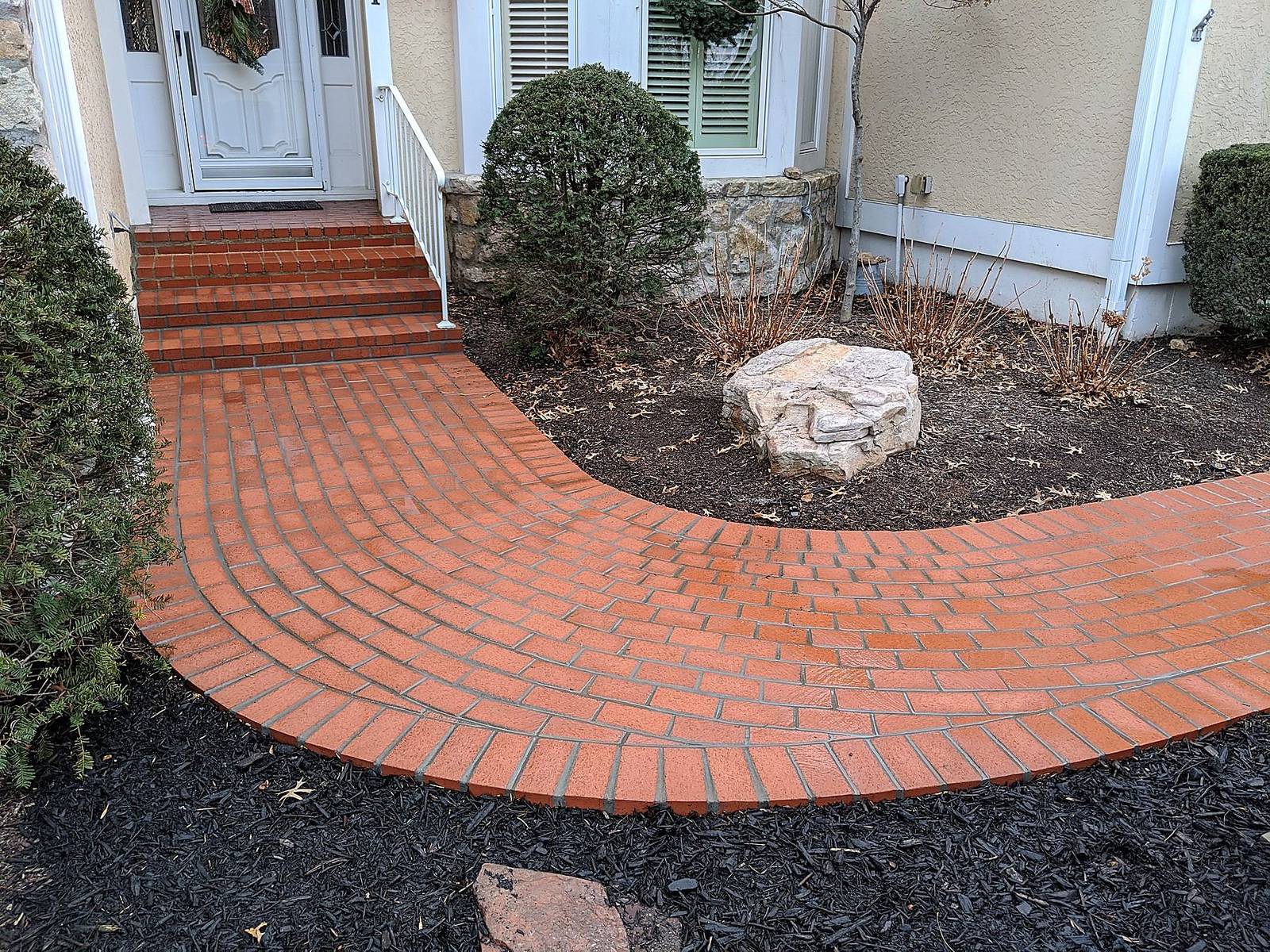
Brick steps and a brick walk. DeepFix photo.
On winter masonry repair Kansas City jobs, the answer is a split decision, not a yes or a no. Some masonry cannot sit through another freeze and thaw. Most new mortar should. The line is about 40°F and rising, and it is about the next few nights, not the warm hour after lunch.
The 40°F-and-rising rule
Mortar does not dry the way paint dries. It cures by hydration. Cement and water react, and that reaction is what turns a wet mix into a joint that can carry load. The water has to stay liquid long enough for the early strength to form. If the water freezes first, the paste is broken apart, and the mortar is weakened for good.
That is why masonry repair below 40 degrees is not a small gamble. Forty degrees and rising means the air, the wall, and the materials are at or above that line, and the day is warming rather than falling into a freeze. A high of 41 with a night of 25 is not a masonry day. The wall does not care what the thermometer said while the mortar was being mixed.
The name cold weather mortar covers the mix and the methods used when the season is close to that line. It is still mortar. It still has to hydrate. Warmer water, heated sand, and a covered cure change the conditions around the joint. They do not change the chemistry.
Winter masonry repair Kansas City: check the trend, not the afternoon
We look at the run of nights, not one pleasant afternoon. Fresh mortar needs days, not a few hours. If the overnight low drops through the freeze while the joint is still green, the work waits or it is protected for that whole stretch.
Kansas City does this in streaks. A mild Tuesday sits between two hard nights. The brick on a south wall can be warm while the north wall, the chimney, and the shaded stoop are still cold to the core. We take the temperature of the masonry we are about to point, not the temperature on the truck.
- Air temperature through the next nights, not just the afternoon high.
- The wall itself. A cold brick pulls heat out of fresh mortar.
- Wind. A joint in the open cools faster than a joint under a porch.
- Whether the work can be covered and kept from freezing until it has strength.
What cannot wait
Some failures get worse every time they get wet, and winter is a wet season here. The permanent mortar may have to wait for a milder stretch. The water and the loose units do not.
- Brick or stone that is loose, bulging, or already falling. That is a safety problem, not a cosmetic one.
- An open chimney crown or a missing cap that is pouring water into the stack.
- Steps or a stoop that have become a trip hazard. Close them off or give them a temporary cover. Reset the masonry when it can cure.
An open crown is the one we hate to leave. Water in the flue and the first courses freezes, thaws, and pries the brick. That is emergency chimney repair winter KC houses actually need: stop the water now, even if the full rebuild of the crown waits. A cracked crown before a Kansas City winter is the longer note on how that water gets in.
Steps are the other one. A loose tread or a settled walk is how someone gets hurt on the way to the car. We would rather block a step for the season than point it on a night that will freeze the joint. Brick steps and stoops before a freeze-thaw winter is the walk-through for salt, open joints, and what to leave alone.
What can still be done in the cold
Cold-weather work is real work. Materials can be heated. The wall can be tented. The cure can be covered and kept at or above 40°F until the mortar has its early strength. That setup takes more time than an open-air day in May. It is still legitimate masonry when the 40°F-and-rising rule holds under the cover. Heat does not turn a falling temperature into a pointing day.
Can you tuckpoint in winter? Only when the 40°F-and-rising rule holds for the whole early cure. Staying merely above freezing is not enough. A night at 33°F is still masonry repair below 40 degrees. The joint, the brick, and the air around them have to be at or above 40 and not headed into a freeze. A small patch on a protected wall is not the same job as a whole elevation in the wind.
Heated water and warm sand do not make a frozen wall fair game. If the units are glazed with ice, or the cores of the brick are below freezing, the fresh mortar loses its heat to the masonry and freezes from the back. Protection has to include the wall, not only the bucket.
What does not depend on the weather
Interior work does not follow the outdoor rule. A firebox, a hearth, a surround, and the masonry inside a heated room can be repaired while the yard is frozen. The flue and the crown above the roof are still exterior. We keep those two apart when we talk about a fireplace in January.
Looking at a wall does not require 40 degrees. A chimney, a stoop, or a foundation can be read in any weather: what is loose, what is only weathered, and what should stay covered until the nights stay up. An estimate written in the cold is still only an estimate. It is not a start date for the mortar.
Stone veneer in the cold
The usual stone veneer cold weather failure starts behind the stone, not in the face you can see. The stone is a skin. Flashing at the base, at windows, and at the roof, and weeps that are actually open, decide whether water behind that skin can leave. A veneer set on a frozen substrate bonds to a surface that will move when it thaws.
We do not set veneer on a frozen backup to stay on a calendar. If the backup is sound and the temperature can be held, the work can proceed with the same cover and heat as any other mortar. If it cannot, the stone waits.
The red flag
The job to walk away from is tuckpointing on a hard freeze with no tent, no heat, and no cover. The joints will look full when the crew leaves. They will dust, crack, or fall out after the first real thaw. That is not winter skill. It is a joint that never cured.
Ask what happens to the wall overnight. If the answer is that it should be fine, ask again. A covered cure is a method. A guess is not. The same question separates a joint repair from a wall that has already moved. Tuckpointing or a rebuild is that call, and cold weather does not make a bowed wall into a pointing job.
Get on the list before the mild stretch
If the masonry can wait, the useful step is to be in line for the first stretch of nights that stay at or above 40 and rising, not to force the mortar while those nights still freeze. No start day is named here. The cure window is the test.
Soft next step
Text photos of the loose brick, the crown, or the step to (816) 226-8020, or email deepfixllc@gmail.com. Wide shots and a close shot of the open joint are enough.
Send the photos. The cure window decides what can be mortared, and what should wait.