
Blog · October 27, 2026
Brick steps and stoops before a Kansas City winter: fix the joints now, go easy on the salt
Front steps take the worst of a KC winter. Close the open joints before the freeze, and go easy on the salt so it doesn't flake the brick.
Restoration
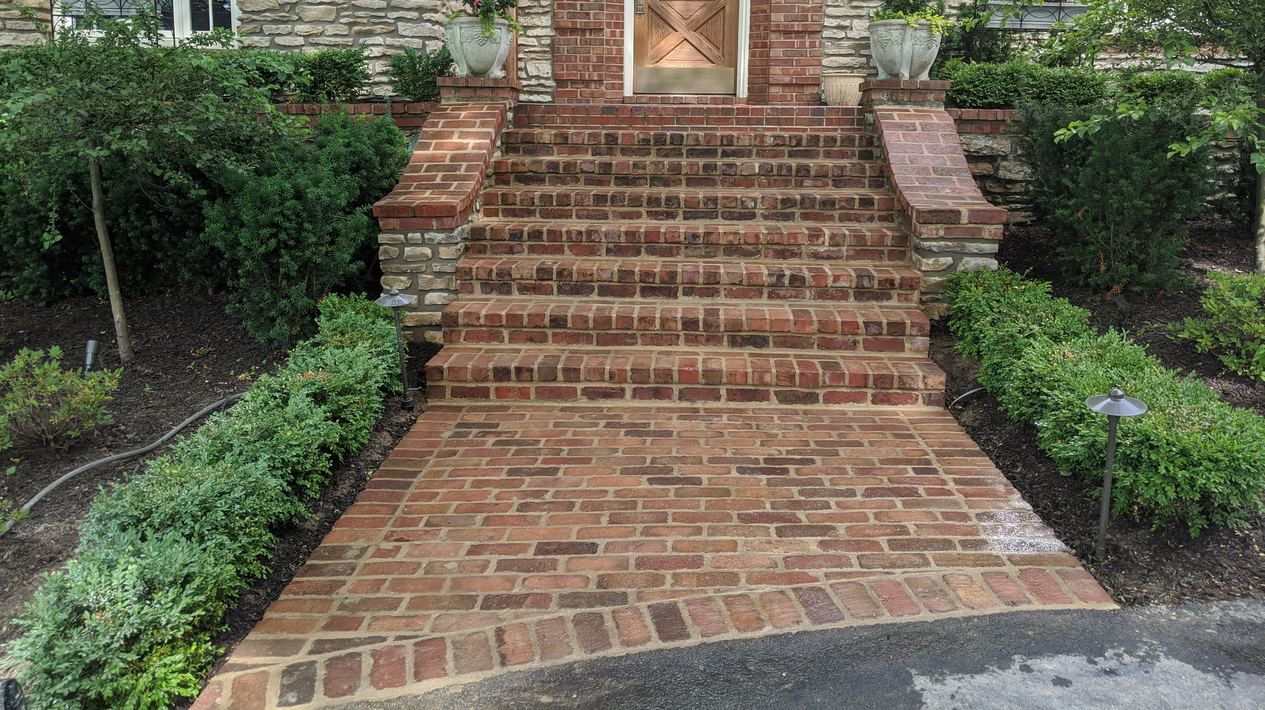
Brick entry steps with sound joints and cheek walls.
Front steps fail before the walls do. They sit flat, so rain and snow stay on them. Feet work the joints every day. The bottom courses take the most, because that is where snow gets piled and where the salt goes. If you are looking at brick steps repair Kansas City houses need before a hard freeze, start with those treads, not with a coating.
The National Weather Service puts the average first freeze around October 17 in Lee's Summit and around October 28 in Kansas City. That is the window. Close the open joints while the masonry can still dry, before that water has a night to freeze inside it.
Read your steps: a 10-minute walk-around
Walk the stoop on a dry day, then again after a rain. Stoop repair Kansas City homeowners can do for themselves starts with looking. You do not need a ladder. You need ten minutes and a decent look at the joints.
- Open or sandy joints. Mortar that brushes out with a finger, or joints that sit back from the face, are holding water.
- Flaking or popped brick faces. A face that has already left the unit is not dirt. It is the brick giving up its skin.
- Loose treads or caps. A cap that rocks, or a tread that sounds hollow, is no longer tied to the step under it.
- White crust along the base or on the cheek walls. That is usually salt the water left behind, not dust from the street.
- A downspout, a gutter outlet, or a sprinkler head pointed at the steps. The stain is the symptom. The water path is the job.
If that white crust keeps coming back in the same spot, it is telling you where the water travels. The longer note on that powder is white powder on your brick.
What salt actually does
Salt does not melt the ice and then vanish. Salty water wicks into the brick and the mortar. It moves toward the drier face, the water leaves, and the salts crystallize just under the surface. That is subflorescence. Guidance written for brick describes it as damage working behind the face, not a film you can scrub off. The same guidance on historic masonry treats deicing salt as something that breaks the unit from the inside.
Freeze-thaw brick damage uses that path. Water in the pore freezes, takes more room, and opens the pore a little. The next thaw lets more salty water in. The face pits and frets. We call that salt fretting. Rock salt brick damage shows up as flakes on the treads, sandy joints at the bottom course, and rust at a railing post set in the masonry. The steel swells as it rusts and jacks the brick around the pocket.
De-ice without wrecking the brick
The best ice melt for brick steps is the smallest amount that keeps the walk safe, and preferably not on the brick. Shovel first. Sand gives traction and does not feed the masonry. If you use a deicer, put a light dose on the walk, not a broadcast across the treads and the cheek walls.
Do not use products built on ammonium nitrate or ammonium sulfate. They are hard on brick, mortar, and the metal set into the steps. When the freezing weather is over, rinse the white residue off so it does not sit there until the next storm. Keep the walk safe and clear. Check your city's rules for clearing walks.
Don't seal it shut
A coating can look like the careful move and still make spalling brick steps worse. If the film blocks evaporation, water and salt stay just behind the face. The next freeze pops more of the unit off. Brick guidance on salts is direct about this: a sealer that stops the wall from drying can drive the damage you were trying to prevent. Any water repellent on a stoop has to stay vapor-permeable, and it comes after the joints are sound, not instead of them.
The fall note on that order is waterproofing masonry before a Kansas City winter. We do not paint the brick shut and call the steps protected.
Brick steps repair Kansas City: water first
Stop the water before you point a joint. Move the downspout. Fix the gutter that dumps on the bottom tread. If a sprinkler wets the cheek wall every morning, that wetting is part of the repair, not a separate yard issue.
Then the joints. Porch step tuckpointing means cutting out the failed mortar and packing a new joint that is softer than the brick. Hard mortar in a soft old tread makes the brick take the stress. The face spalls. The joint stays. Matched mortar on old Kansas City brick is how that mix, the sand, and the joint profile belong to the steps that are already there.
Loose caps and treads get reset so they bear again, on a full bed, not a dab of adhesive. Replace only the units that have lost their face, and replace them with matched brick so the repair does not read as a patch from the sidewalk. Steps that have heaved, split, or lost their base are a different call. A partial rebuild on a sound base beats pointing a stair that has already moved.
How we call tuckpointing or a rebuild is the same line we use on a wall. Sound units that still sit plumb can be pointed. Masonry that has shifted comes out. We say which one it is before the first joint is cut.
Soft next step
Text photos of the treads, the cheek walls, and the joints to (816) 226-8020, or email deepfixllc@gmail.com. The on-site look is free. We do cold-weather masonry, so a mild day can still be a repair day after it turns cold.
Send a photo of your steps. We'll tell you what they need before the freeze.